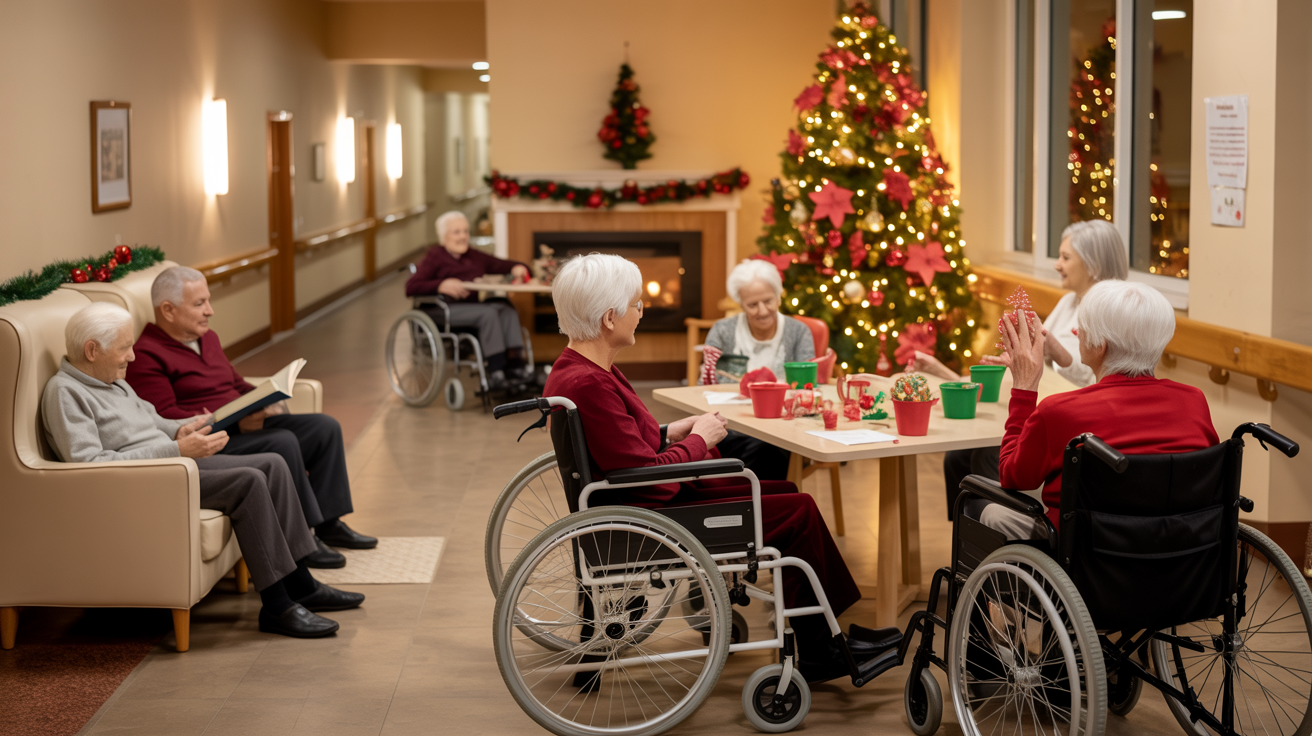
Christmas at a senior center has its own kind of magic: familiar songs, twinkling lights, shared cookies, and the warmth of “we’re doing this together.” But the holiday season also quietly changes your building’s risk map. A single extension cord can become a trip hazard. A cozy rug can curl at the corner. A bright display can overwhelm someone with dementia. And a crowded hallway can turn a minor stumble into a major incident.
This guide is a practical, senior-center-first safety checklist for the most common holiday hazards—trip points, cords, lighting, entry rugs, fall-prevention, sensory overload, and fire safety—plus specific ways to reduce risk without draining the joy out of the season.
Before you decorate: do a “holiday walk-through” in 10 minutes
Start with a quick walk-through while looking at the building like a first-time visitor using a walker, cane, or wheelchair. Ask yourself:
Are pathways wide, clear, and consistent from parking lot to front desk to main room?
Are there new objects at ankle-height (boxes, décor stands, cords) where feet and walkers will go?
Did we add anything that changes lighting (glare, shadows, flashing, dim corners)?
Do we have a plan for crowds, noise, and sensory breaks during events?
Trip hazards: the “small stuff” that causes big falls
Holiday décor often adds low, unexpected objects where people naturally turn, pause, or pivot. These are the most common trouble spots in senior centers:
Decoration stands at corners (where people cut turns).
Gift boxes, bins, or donation barrels placed near entrances or in hallways.
Table legs and chair legs crowded closer together for parties.
Loose garland or tinsel that droops into walking space.
Temporary signage (A-frame signs) placed in the center of paths.
Safer setup tips:
Keep main paths “boring on purpose”: no décor at ankle height within the primary flow route.
Move displays to wall zones or corners outside of turning radius and doorway swing areas.
Use high-contrast tape to mark any unavoidable base plates or stand feet.
During events, assign one “traffic watcher” to keep chairs from creeping into walkways.
Cords and cables: holiday lights and AV setups without the hazards
Between string lights, speakers, microphones, and projector cords, December can quickly turn into a cable jungle. For older adults, a cord doesn’t need to be thick to be dangerous—just unexpected.
Checklist for cord safety:
Route along walls, not across walking lanes. If it must cross, use a commercial cord cover (not a throw rug).
Eliminate daisy-chaining. Avoid plugging power strips into power strips.
Minimize slack. Coil and secure excess length so it can’t loop around feet or mobility aids.
Secure at the edges. Use gaffer tape (preferred for events) rather than slick household tape that peels or becomes slippery.
Protect the plug zone. Keep outlets and plug clusters out of high-traffic areas; add a small barrier or relocate furniture to discourage foot traffic.
Quick win: If you can switch to battery-powered décor (candles, mini-lights, window displays), you remove cords entirely—and you reduce electrical load risk at the same time.
Lighting: reduce glare, shadows, and “surprise darkness”
Holiday lighting looks beautiful—but contrast and glare can be disorienting, especially for low vision, cataracts, or balance issues. Dark corners and bright spotlights can also make depth perception harder during transitions (entryways, restrooms, hallways).
Senior-center lighting best practices for the holidays:
Prioritize even lighting in walk zones. Save “twinkle” lighting for display areas, not pathways.
Avoid flashing or strobing effects in common areas (they can trigger dizziness, headaches, and sensory distress).
Reduce glare on floors. Watch for shiny surfaces where reflections look like wet spots or holes.
Light the transitions. Ensure entrances, ramps, and restroom routes are well lit for the entire event—not just when the building is “fully on.”
Use contrast cues. Clear, high-contrast signage for restrooms and exits helps people navigate without rushing.
Entry rugs and mats: the classic “welcome” hazard
Seasonal entry rugs can be one of the highest-risk items you add—because they’re right where people are stepping in from wet, uneven surfaces, while juggling coats and bags.
What to look for:
Curling edges and corners that lift.
Thick pile that grabs canes, walkers, and shoes.
Sliding on tile or polished floors.
Dark-on-dark patterns that hide edges for low vision.
Safer rug rules:
Use low-profile, non-slip commercial mats with beveled edges.
Secure mats with anti-slip backing or professional-grade tape designed for floors.
Keep mats flat and replace immediately if they won’t lay down perfectly.
Consider removing decorative rugs entirely during large events—keep only functional entry mats.
Fall-prevention during events: plan for crowds, fatigue, and “holiday pace”
Even if your building is hazard-free, fall risk rises when people are excited, moving faster than usual, or fatigued. Add holiday desserts (blood sugar swings), long programs, and a packed room, and prevention becomes a team sport.
Event-day fall-prevention moves that work:
Stagger arrival and check-in. Reduce bottlenecks at entrances and coat areas.
Create a clear mobility lane. Keep one wide route for walkers/wheelchairs through the main room and to restrooms.
Stable seating layouts. Avoid squeezing extra chairs into aisles; leave turning space near tables.
Rest breaks are safety breaks. Build short pauses into longer programs so people don’t rush to stand up all at once.
Floor checks mid-event. Assign a staff member to scan for spills, dropped napkins, or creeping cords every 20–30 minutes.
Footwear reminders. A friendly sign at check-in (“Supportive shoes help everyone enjoy the day!”) can reduce slippery-sock surprises.
Sensory overload: protect joy for people with dementia, anxiety, or low tolerance for noise
Holiday environments can unintentionally overwhelm: loud music, busy décor, crowd chatter, strong scents, and constant movement. For some older adults—especially those living with dementia—overload can lead to agitation, confusion, wandering, or sudden shutdown.
Make Christmas calmer without making it boring:
Create a “quiet corner” or calm room. Soft lighting, minimal décor, comfortable seating, water, and a staff check-in schedule.
Use sound intentionally. Keep music at a level that still allows conversation; avoid sudden volume changes.
Limit strong fragrances. Consider a “fragrance-light” policy for big events (especially around candles, sprays, and potpourri).
Offer choice. Provide both high-energy and low-energy activities (crafts, gentle sing-alongs, puzzle tables).
Use clear visual cues. Simple signage and consistent room layout reduce confusion and wandering.
Tip for staff/volunteers: If someone seems “not themselves,” try reducing stimulation first—lower the sound, guide to a calmer space, offer water, and slow down communication.
Fire safety: Christmas décor without the “we hope nothing happens” feeling
Holiday fire risk is usually a combination of three things: heat sources, overloaded electricity, and blocked exits. Senior centers can reduce all three with a few non-negotiables.
Holiday fire safety checklist:
Use battery-operated candles instead of open flames in all common areas.
Inspect all light strings. Replace anything with frayed wires, warm plugs, or loose connections.
Don’t overload outlets. Spread décor across circuits; avoid power-strip stacks.
Keep exits and extinguishers clear. No trees, tables, gift piles, or photo backdrops in exit routes.
Kitchen caution. If you’re using warmers, crockpots, or buffet heating trays, keep cords managed, surfaces stable, and a dedicated “hot zone” away from traffic.
Know your plan. Review evacuation roles with staff and volunteers before the event begins.
If your center uses a real tree for any reason, follow local code, keep it hydrated, and keep it away from any heat source or exit route.
Printable-style safety checklist table
Area
What to check
Fix on the spot
Who owns it
Entry & Lobby
Mats flat, non-slip, no curled corners; clear coat-drop zone
Replace/secure mats; move bins/displays off the main path
Front desk lead
Hallways
Clear width for walkers/wheelchairs; no décor at ankle height
Relocate displays; remove A-frame signs from center lanes
Facilities / volunteer captain
Main Room
Chair spacing; mobility lane to restrooms; cords controlled
Re-space seating; add cord covers/gaffer tape; mark hazards
Program manager
Lighting
No dark corners; minimal glare; no flashing lights in walk zones
Add lamps/night lights; move twinkle displays to walls/corners
Facilities
Power & Décor
No daisy-chains; plugs not hot; cords not crossing pathways
Reduce load; redistribute outlets; switch to battery décor
Facilities
Fire & Exits
Exits clear; extinguishers accessible; hot food zone controlled
Quiet space available; music level steady; scent minimized
Set up calm room; lower volume; remove strong sprays
Activities coordinator
Resources to keep handy (and share with staff & volunteers)
To make safety easier year-round, keep a short “resource stack” bookmarked. Here are a few reliable places to start, plus one internal checklist you can adapt for your center:
One last move: appoint a “Safety Lead” for every holiday event
The simplest way to reduce holiday incidents is to make safety someone’s named role—just for the duration of the event. A Safety Lead does quick scans, handles small fixes immediately (spill cleanup, chair drift, cord re-tape), and knows who to call if something needs facilities support. When safety is owned, the whole room relaxes—and everyone gets to enjoy the season.
Browse thousands of Senior Centers from around America. Senior Centers are an integral part of society and are the center of life for many seniors and aging adults.
Find a Senior Center which fits your needs using our search feature and keep up to date on all the latest news.
Advertisers are not endorsed by SeniorCenters.com or any senior center listed. This site is not endorsed by or affiliated with any senior center or organization listed.
To provide the best experiences, we use technologies like cookies to store and/or access device information. Consenting to these technologies will allow us to process data such as browsing behaviour or unique IDs on this site. Not consenting or withdrawing consent, may adversely affect certain features and functions.
Functional
Always active
The technical storage or access is strictly necessary for the legitimate purpose of enabling the use of a specific service explicitly requested by the subscriber or user, or for the sole purpose of carrying out the transmission of a communication over an electronic communications network.
Preferences
The technical storage or access is necessary for the legitimate purpose of storing preferences that are not requested by the subscriber or user.
Statistics
The technical storage or access that is used exclusively for statistical purposes.The technical storage or access that is used exclusively for anonymous statistical purposes. Without a subpoena, voluntary compliance on the part of your Internet Service Provider, or additional records from a third party, information stored or retrieved for this purpose alone cannot usually be used to identify you.
Marketing
The technical storage or access is required to create user profiles to send advertising, or to track the user on a website or across several websites for similar marketing purposes.